Attachment wounds form quietly. A missed pickup at school that becomes a pattern, a parent who shows up drunk on the night of the recital, a partner who says nothing as you cry, a friend who disappears after promising to be there. The body remembers these moments as threats to connection. Over time the nervous system starts to organize around protection, not closeness. People describe it as walking into relationships with a flinch.
In therapy rooms, attachment injuries show up in dozens of ways. Some clients work hard to please everyone and still feel unloved. Others keep distance, convinced that independence is safer than hope. Couples argue about chores, but the real pain sits underneath, a fear that no one will choose them when it matters. Children might seem defiant or shut down, yet their behavior often maps to a simple question: Can I trust that you are here with me?
This is where trauma therapy can help. When we treat attachment wounds, we are not only easing symptoms. We are rewiring how the brain and body expect connection to go.
What attachment wounds are made of
Attachment research gives us a helpful frame, but you do not need a textbook to recognize the pattern. Attachment wounds accumulate when care is inconsistent, misattuned, punitive, or absent. They can come from big events like separation and abuse, and from small repeated misses, the parent who is loving but depressed, the caregiver juggling three jobs and never quite present.
The nervous system takes its cues from early relationships. A baby cries, someone comes, the world feels safe. A baby cries, no one comes, the world becomes uncertain. By the time that baby becomes an adult, the body is already rehearsed. In stress, the heart rate jumps, muscles brace, attention narrows, and the mind predicts rejection or criticism before any words are said. These are not character flaws. They are learned survival strategies.
Clients often say, I know my partner cares, but my body does not believe it. That split is the essence of attachment injury. The thinking brain, the prefrontal cortex, holds insight. The survival systems, amygdala and brainstem circuits, hold reflex. Therapy must speak both languages.
How attachment injuries play out in daily life
When a wound gets touched, people tend to protest, pursue, withdraw, or numb. The behaviors look different on the surface, but the engine underneath is similar. Protest says, notice me and prove you care. Withdrawal says, I will protect myself by going quiet. Numbing says, I will not feel this again.
A client I will call Maya had a familiar pattern. If her partner stayed late at work and did not text, she felt an electric rush of panic, then anger. She would send hard messages, You never think of me, and later feel ashamed. Once we slowed down what happened in her body, she noticed her chest tighten at 5:30, her thoughts race, her palms sweat, and her impulse to type before she could breathe. Her childhood held long evenings waiting for a parent who did not come home on time. Of course her body moved fast. It was trying to protect her from being the little girl left alone at the window.
Another client, Jamal, went the other way. If his partner asked for more closeness, he felt flooded, then numb. He could not find words. He would leave the room for long stretches. In his family, feelings were not discussed, mistakes were punished, and any need was risky. When intimacy deepened, his system pulled the emergency brake. Numbness was his best idea at safety.
In both stories, the key is to recognize the pattern without shaming it. The nervous system did its job. Now the job has changed.
What effective trauma therapy looks like for attachment wounds
Attachment healing depends on two forces working together. First, the therapist builds a relationship that is predictably safe and honest. Second, the therapy offers methods that help the body and mind renegotiate old patterns. You can think of it as corrective experience plus targeted rewiring.
The relationship piece is not soft filler, it is the frame for everything else. Predictable session times, clear boundaries, repair after misattunements, and a therapist who tracks your cues with care. Good trauma therapy moves at the pace of trust. If a technique pushes you into overwhelm every session, your system will learn only to brace.
On the methods side, there are several paths. EMDR therapy uses bilateral stimulation while you hold fragments of memory, belief, body sensation, and current triggers in mind. Well delivered, it helps the brain digest stuck material so it can move from alarm to completion. For attachment work, EMDR often focuses on early memories of aloneness, shame, or misattunement, then connects them to present day relationship triggers. I typically map a target sequence, from earliest attachment memories to the pattern that plays out today, then weave in resourcing that matches what was missing, comfort, protection, attunement.
Parts based therapies, like Internal Family Systems or ego state work, allow you to meet the protectors who step in when intimacy feels risky. The angry texter is not a monster, it is a https://cruzeogc144.fotosdefrases.com/couples-therapy-communication-scripts-that-reduce-defensiveness part that learned yelling might get someone to stay. The numb improviser is not cold, it is a part that saves you from punishment. When protectors are respected instead of pushed aside, they often relax enough to let healing reach the exile, the younger hurt that carries the loneliness.
Somatic approaches add a missing layer. Attachment lives as posture and breath as much as thought. Interventions might be as simple as tracking the moment your shoulders rise, then practicing a settling breath before sending that message. Or you might experiment with one minute of eye contact that is time boxed, with your therapist or partner as a co-regulator, not a judge. This is exposure with compassion, small doses of closeness while the body learns it will not break.
Signs you are dealing with an attachment wound, not just a communication problem
- The intensity of your reaction far exceeds the size of the current trigger, even when you understand the facts. Your body reacts first, racing heart, tight chest, heat in the face, or full numbness, and language lags behind. The same argument repeats with different content, money this week, chores next week, but the same fear underneath. Apologies and logic help for a moment, then the old belief returns, I am not important, or people always leave. You vacillate between clinging and pushing away, or between over explaining and going silent.
These patterns do not prove pathology. They point to where healing will matter most.
Couples therapy as an arena for repair
Individual therapy strengthens your inner scaffolding. Couples therapy adds a second layer, live practice with the person who matters most. The best couples work for attachment injuries blends structure with warmth. I often use an emotionally focused lens. First, we slow the cycle. What does each partner do in the first 30 seconds of distress, and what fear does that move protect. Second, we help each partner put that fear into words the other can hear.
With Maya and her partner, we built a pattern break. She learned to label the body signal, My chest is tight and my mind is writing a story that you forgot me, then ask for a check in. Her partner learned to send a predictable message at 5:15, I am in meetings until 6, thinking of you, home by 6:30. It was not romantic poetry. It was regulated structure that calmed a storm. Once the storms calmed, deeper work could begin, grief for the earlier windowsill waiting, and new shared rituals that marked presence.
With Jamal and his partner, the task was different. We practiced time limited vulnerability. He would share one feeling in two sentences, then his partner would reflect without adding a fix. Three rounds, then a break. The container helped his nervous system tolerate contact without fear of interrogation. Over months, his capacity grew. He could stay in conversations that previously felt like drowning.
Trade offs exist. In couples therapy, progress can stall if one partner is not ready to engage, or if there is ongoing betrayal or active substance misuse. In those cases, individual trauma therapy or a period of stabilization may need to come first.
Child therapy and the early course correction
Attachment wounds often start early, so child therapy has a powerful role. Children do not usually benefit from talk heavy sessions. Their language is play and movement. A well trained child therapist will use play therapy to watch how a child approaches closeness, control, and repair. If a child repeatedly smashes the tower you build and watches your face, they may be testing, Will you stay if I am too much.
Parent involvement is not optional. I ask caregivers to join parts of most sessions and to practice at home what we build in the room. Simple connection rituals matter more than lectures. A five minute bedtime story with predictable questions can ease night time anxiety. A morning hug of five breaths can set a tone for the day. Consistency teaches the nervous system that care is real.
Kids who have experienced medical trauma or foster care often need more scaffolding. For some, EMDR therapy adapted for children works well, with short sets and more externalization. I might use a feelings thermometer or a safe team of stuffed animals to embody protection. The principle stays the same, digest stuck fear, build new experiences of safety, involve caregivers whenever possible.
Working with neurodivergent clients
Neurodivergent therapy for attachment wounds requires precision. Autistic and ADHD clients often arrive with a lifetime of social misattunements, sensory overload, and masking. What looked like defiance in school was sometimes self preservation in a world of fluorescent lights and noise. Attachment pain sits on top of that. If therapists miss the sensory or processing layer, they may pathologize a protection that is actually wise.

With autistic clients, I pay close attention to sensory needs before I ask for exposure to intimacy. Therapy rooms should not have harsh lighting or chaotic visuals. Sessions benefit from clear structure, visual supports, and explicit consent around eye contact and touch. A client might prefer side by side walks or fidgets while we talk. In couples therapy where one partner is autistic, we often translate implied bids into explicit ones. Instead of, You never want to spend time with me, we build, I want to watch one episode together after dinner at least three nights this week. That clarity reduces mind reading errors that fuel attachment panic.
With ADHD clients, impulse and time blindness can exacerbate attachment injury. A late arrival can trigger shame and conflict even with the best intentions. Practical tools matter, shared calendars with alerts, buffer times before dates, scripted check ins. Medication management and sleep hygiene are attachment interventions by extension, because regulation makes closeness possible.
Some neurodivergent clients find EMDR therapy helpful, others find bilateral stimulation overwhelming. I often start with slower sets, tactile bilateral rather than audio, and more resourcing. Parts work can be a gentle entry when rapid eye movements feel disorganizing.
Why EMDR therapy is a fit for many, and when it is not
EMDR has strong data for PTSD and growing support for attachment related presentations. Its advantage lies in bypassing the bottleneck of cognition. You do not need to generate perfect insights. You stay present with a cluster of memory, sensation, and belief, then let the brain do what it does in REM sleep, connect and integrate. When a session lands well, clients report a felt shift, The moment is still sad, but it no longer feels like danger.
There are limits. If a client dissociates rapidly without warning, if stability at home is low, or if there is ongoing trauma, EMDR may need to be paced carefully or deferred. Some clients prefer relational or somatic work first, then short EMDR blocks to target specific knots. Good clinicians flex. They do not force a protocol to fit a person.
What healing feels like, in practice
Attachment healing does not remove your sensitivity. It turns it from an alarm into a compass. The same body that once flinched can start to signal earlier and more accurately. You notice the first wave of panic, name it, and ask for what you need. Your partner becomes an ally in calming, not the adversary you brace against. The stories shift, from I am too much or I am alone, to I am held and I can hold.
Clients often ask for a timeline. In my practice, people with milder and later onset injuries may see meaningful shifts in 8 to 20 sessions, especially with focused EMDR therapy or structured couples sessions. Those with complex trauma from early years commonly need longer arcs, 6 months to 2 years, sometimes more, with plateaus and spurts. Progress is rarely linear. Sleep improves, then there is a setback after a family visit. You repair faster each time. That is progress.
A compact repair script for partners
When a trigger hits between two people who care for each other, speed and clarity help. Here is a compact structure many couples use in my office.
- Signal the switch from fight to repair with a phrase you both agree on, such as Pause, I want to reconnect. Name the body state and the old story, My chest is tight and my mind says I am not important. Make one doable ask, I need a 10 minute check in, or Please hold my hand while we talk. Offer a reflection in return, I hear you, and what I meant was, I was late because of traffic, not because you do not matter. Close with a small ritual, three breaths together, or a glass of water, that marks the reset.
This is not a cure, it is a bridge. Used consistently, it teaches two nervous systems to find each other when storms rise.
The role of boundaries and grief
People sometimes confuse attachment healing with endless availability. Boundaries are not barriers to love, they are the frame that makes love sustainable. Saying no to a visit when you are exhausted can protect connection in the long run. In therapy, I help clients differentiate attachment panic from true limits. If your body screams when a partner goes away for two days, that is a wound. If you need an hour alone after work to transition, that is a boundary. Both can be honored at once.
Grief is the companion to this work. When you finally feel safe enough, you may sense the weight of what you did not get. A present father who never was, a mother who could not stop drinking, a childhood where you raised siblings at age nine. Letting yourself mourn is not indulgent. It clears space for current love to land. I have sat with clients who wept for fifteen minutes, then breathed easier for months.
What to look for in a therapist
Credentials matter, but fit matters more. Seek someone trained in trauma therapy approaches who also values the relationship. Ask how they pace EMDR therapy for attachment work, how they handle dissociation, and what repair looks like if there is a misattunement in session. Notice how your body feels in the room, not only whether they say the right things. A good therapist invites feedback, explains consent, and can hold both science and tenderness.
For couples, look for training in emotionally focused therapy or other attachment focused models. For child therapy, ask about caregiver involvement. For neurodivergent therapy, ask how they adapt sessions to sensory and processing preferences, and how they avoid pathologizing stims or communication styles.
Everyday practices that compound healing
Therapy does a lot, but the daily rhythm sets the tone. Micro practices teach the nervous system to expect connection.
First, reduce ambiguous silence. Short, predictable updates reduce threat better than occasional grand gestures. Second, add small touch points. A morning check in, a shared walk, a two minute hug with slow exhales. Third, build co-regulation rituals. Music while cooking, a shared puzzle, light stretching before bed. Fourth, protect sleep and nutrition. The prefrontal cortex, your wise thinking brain, works better when you are fed and rested. Fifth, create shared meaning. Celebrate small wins, name the values that guide your choices, volunteer together if that fits you. Purpose helps injured attachment find a home larger than its pain.
Repairing after therapy missteps
Even skilled therapists miss. A word lands wrong, a silence stretches too long, a session ends right as tears begin. In those moments, the repair is the therapy. I try to name my part, check what happened in the client’s body, and collaborate on how to handle similar moments next time. Clients who grew up with fragility often expect that naming a miss will break the bond. Seeing the relationship withstand conflict is corrective at a deep level.
If your therapist becomes defensive or blames you for their misattunement, bring it up again with more clarity. If the pattern persists, it may be time to consult or switch. Attachment work relies on a stable, responsive connection.
When trauma therapy and medication meet
Medication is not a cure for attachment wounds, but it can lower the noise floor. For clients with severe anxiety, depression, or ADHD, appropriate medication makes the nervous system more receptive to therapy. I often collaborate with prescribers to time dose adjustments with emotionally intense phases of work. The aim is not to erase feeling. It is to make feeling tolerable enough that learning can occur.
Cultural and context factors that shape attachment
Attachment lives inside culture. Immigration stress, racism, homophobia, poverty, and disability stigma all alter the landscape. A Black client who reads threat in authority may carry generations of learned vigilance. A queer teen rejected at home may have good reason to keep their needs quiet. Good therapy names these realities and does not turn systemic harm into personal pathology. At the same time, we look for islands of safety and agency. Community can buffer attachment injuries. A consistent coach, a trusted aunt, a group where your identity is celebrated, each can be a corrective experience.
What progress looks like in numbers and moments
You can measure some of this. Panic attacks drop from three a week to one every two weeks. Sleep improves from five hours to seven. Fights that once lasted two days now resolve in 45 minutes. You catch yourself before sending the third accusatory text. You ask for a hug rather than testing if your partner will notice your silence.
The more important measures hide in small moments. You feel a surge of fear and your hand goes to your chest, not your phone. Your child stomps and you lower your voice, and they soften. You sit at a family dinner and know your worth without performance. These are the landmarks of a nervous system that trusts connection.
The long view
Attachment wounds form in relationship and heal there. Trauma therapy gives you tools, and more than that, it offers a live rehearsal space where your body can relearn safety. EMDR therapy helps the brain complete old sequences. Couples therapy teaches two people to catch a cycle and choose each other. Child therapy shifts a trajectory early. Neurodivergent therapy honors the body you have, not the one others expect.
The work is not about becoming invulnerable. It is about becoming well connected, to yourself first, then to those who can meet you. When connection returns, even slowly, the world looks different. You do not have to argue with your nervous system. It joins you. You can see your partner as they are, not as the ghost of those who hurt you. You can look at your child and feel steady enough to be the anchor they need. That is restoration, not perfection, a life built on relationships that can bend without breaking.
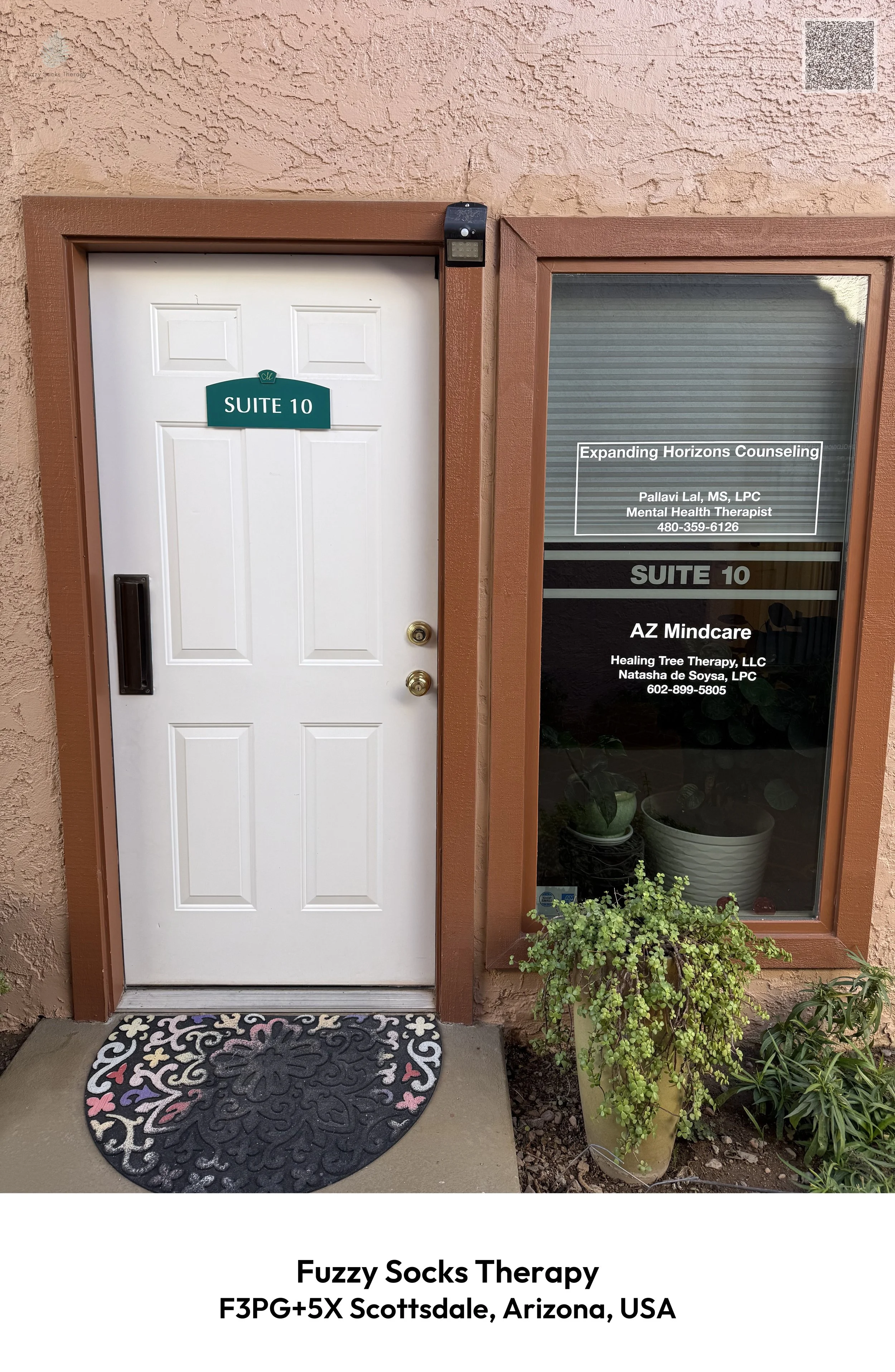
Address: 3295 N. Drinkwater Blvd., Suite 10, Scottsdale, AZ 85251
Phone: (720) 378-8454
Website: https://www.fuzzysockstherapy.com/
Email: [email protected]
Hours:
Monday: 9:00 AM - 5:00 PM
Tuesday: 9:00 AM - 5:00 PM
Wednesday: 9:00 AM - 5:00 PM
Thursday: 9:00 AM - 5:00 PM
Friday: 9:00 AM - 5:00 PM
Saturday: Closed
Sunday: Closed
Open-location code (plus code): F3PG+5X Scottsdale, Arizona, USA
Map/listing URL: https://maps.app.goo.gl/cqhwvXU4UMg6QL1YA
Embed iframe:
The practice offers in-person therapy in Scottsdale along with online sessions for clients in Arizona, Colorado, and Florida.
Clients can explore services such as trauma therapy, EMDR therapy, Deep Brain Reorienting Therapy, neurodivergent therapy, child therapy, couples therapy, discernment counseling, and parenting intensives.
Fuzzy Socks Therapy is especially relevant for people navigating trauma, dysfunctional family dynamics, ADHD, autism, relationship conflict, and emotional overwhelm.
The website presents a direct, practical therapy style focused on real tools and meaningful change rather than vague advice.
Scottsdale clients looking for trauma-informed psychotherapy can find support that combines deeper healing work with concrete skill building.
The practice also offers help for adult children of dysfunctional families, couples on the brink, and neurodivergent kids, teens, and adults.
To get started, call (720) 378-8454 or visit https://www.fuzzysockstherapy.com/ to book a free consultation.
A public Google Maps listing is also available for Scottsdale location reference alongside the official website.
Popular Questions About Fuzzy Socks Therapy
What does Fuzzy Socks Therapy help with?
Fuzzy Socks Therapy helps with trauma, dysfunctional family patterns, neurodivergence, relationship conflict, emotional overwhelm, and related challenges for individuals, couples, and families.
Is Fuzzy Socks Therapy located in Scottsdale, AZ?
Yes. The official website lists the office at 3295 N. Drinkwater Blvd., Suite 10, Scottsdale, AZ 85251.
Does Fuzzy Socks Therapy offer in-person and online sessions?
Yes. The official site says the practice offers in-person therapy in Scottsdale and online therapy in Arizona, Colorado, and Florida.
What therapy approaches are listed on the website?
The website highlights EMDR therapy, Deep Brain Reorienting Therapy, discernment counseling, play therapy, Dialectical Behavior Therapy, Emotionally Focused Therapy, and practical trauma-informed skill building.
Who provides therapy at Fuzzy Socks Therapy?
The official website identifies the therapist as Lianna Purjes.
Does the practice offer couples counseling?
Yes. The website includes couples therapy, couples intensives, and discernment counseling for couples deciding whether to stay together or separate.
Does the practice work with children and adolescents?
Yes. The site says the practice offers child therapy and support for children, adolescents, and their families.
How can I contact Fuzzy Socks Therapy?
Phone: (720) 378-8454
Email: [email protected]
Website: https://www.fuzzysockstherapy.com/
Landmarks Near Scottsdale, AZ
Drinkwater Boulevard is the clearest local reference point for this office and helps nearby clients place the practice in Scottsdale. Visit https://www.fuzzysockstherapy.com/ for service details.
Old Town Scottsdale is a familiar city landmark and a practical reference for people searching for therapy near central Scottsdale. Call (720) 378-8454 to learn more.
Scottsdale Civic Center is another recognizable local landmark that helps define the surrounding area for nearby professional services. The official website has current contact details.
Scottsdale Stadium is a well-known destination in the city and a useful point of reference for local users. Fuzzy Socks Therapy offers both in-person and online sessions.
Indian School Road is a major corridor that helps many residents orient themselves in Scottsdale. More information is available at https://www.fuzzysockstherapy.com/.
Fashion Square and the surrounding central Scottsdale area are widely recognized by local residents and visitors alike. Reach out through the website to book a free consultation.
Downtown Scottsdale is a strong local search reference for people seeking counseling and psychotherapy services in the area. The practice serves Scottsdale in person and multiple states online.
Scottsdale Road is another major route that helps define the broader service area for clients traveling from nearby neighborhoods. The practice supports individuals, couples, and families.
The Scottsdale arts and civic district is a useful area reference for those familiar with the city center. Visit the site to review specialties and next steps.
Central Scottsdale commuter corridors make this practice relevant for nearby residents who want in-person therapy, while online sessions add flexibility for clients in Arizona, Colorado, and Florida.