Safety is not an idea, it is a felt experience. People who carry trauma often say they know they are safe on paper, yet their body does not believe it. The heart races in a quiet room. Sleep feels like a risk. A slammed door from a neighbor replays a scene from years ago with the clarity of last night. Trauma therapy aims to close that gap between knowing and feeling, so your mind, body, and relationships can finally agree that the present is different from the past.
I have watched clients shift from white-knuckled coping to genuine ease, not because life removed every stressor, but because their nervous system learned to settle again. This work is slow in moments and surprisingly fast in others. It rarely moves in a straight line. Still, there are reliable ways that safety is rebuilt, piece by piece.
What trauma does to the sense of safety
Trauma is not only what happened. It is also what did not happen afterward: support that never came, a chance to complete a protective response that got interrupted, the reassurance your body needed but could not find. When that loop stays open, the nervous system tries to keep you ready for the next hit. You see this readiness across three patterns, often shifting within the same day. Hyperarousal looks like panic, irritability, insomnia, and hypervigilance. Hypoarousal looks like numbness, fogginess, fatigue, and a sense of disconnection. A third pattern blends both, for example feeling frozen on the outside while the mind races.
These states are not character flaws. They are the body’s attempt to protect you using old data. Trauma therapy helps update the data using present-day experience that is safe, consistent, and under your control.
The first task: establishing actual safety, not just comfort
Therapy cannot ask your nervous system to process old danger while new danger remains active. So the beginning involves looking at current stability. Are there ongoing threats, like a violent partner, an unsafe workplace, or housing instability? Sometimes “trauma therapy” is helping someone craft a safety plan, contact a shelter, work with HR, or build a financial runway for a separation. Until the present has enough safety, deeper processing waits.
Comfort is valuable, but it is not the same as safety. A weighted blanket can soothe, yet if you still see the person who hurt you every week, your body will not buy it. I encourage clients to be honest about their reality, then choose one or two concrete changes that reduce risk by even 10 to 20 percent. Small wins compound. Over months, this lowers the background threat level enough for the rest of the work to stick.
Stabilization: teaching the body a new normal
Before touching the heart of the trauma, we build skills that teach the nervous system how to shift states on purpose. This is the most underestimated phase, and the one that prevents most crises.
Here are five simple practices I return to often:
- Orienting: turn your head slowly and name five things you see, three things you hear, and one thing you can feel under your hands. This tells the midbrain the threat is not here. Temperature shift: hold an ice pack wrapped in a cloth against the chest for 30 to 60 seconds or splash cool water on the face. This can interrupt panic and reset breathing. Paired breathing: inhale through the nose for four counts, hold for two, exhale for six. Longer exhales encourage the parasympathetic system to engage. Grounded movement: press your feet into the floor while seated, then push your hands against your thighs for a few seconds. Many bodies need pressure to find “here.” Micro-choices: pick one thing in the next hour that you can choose freely, even if it is small. Choice tells the nervous system the freeze is thawing.
Stabilization also means building routines that are boring in the best way: regular meals, steady sleep windows, and predictable social contact. If a client tells me symptoms spike at 3 p.m., we brainstorm a snack with protein at 2:30, a ten-minute walk at 2:45, and a text check-in with a friend at 3:15. The nervous system loves rhythm. Trauma breaks rhythm. Therapy restores it.
What processing actually looks like
Many people think trauma processing means retelling the worst moments in graphic detail. Good trauma therapy rarely starts there, and often does not need that level of detail at all. We aim to access the stuck memory networks just enough for change, not to re-traumatize.
EMDR therapy is one well-studied approach. It uses bilateral stimulation, such as eye movements or alternating taps, while you hold specific parts of the memory in mind. The combination helps the brain integrate the experience so it becomes a past event rather than a present alarm. The first few sessions are spent on preparation and resourcing. Then we target memories, body sensations, or future triggers in short, contained sets. Clients often say, “It still happened, but it feels farther away,” or “I can see the scene without my chest clamping down.”
Other methods work through a similar principle. Somatic approaches focus on body sensations and the incomplete defensive responses that want to finish, like pushing away or running. Parts work helps people identify inner voices that hold different jobs, for example a critic that tries to prevent risk, a child part that carries fear, and a competent adult that can lead. Prolonged Exposure uses repeated, controlled revisiting of the trauma memory or trigger, which reduces avoidance and teaches the brain that remembering is not the same as reliving. Cognitive processing helps untangle beliefs like “It was my fault” or “I am permanently broken.”
Choice of method depends on your history, preferences, and nervous system profile. A veteran with tightly organized avoidance may benefit from the structure of exposure. A survivor with strong dissociation may need slower somatic pacing and parts work before any direct memory processing. Clients who prefer less verbal detail often do well with EMDR therapy because it keeps language minimal and tracks body shifts closely.
The paradox of pace
Going faster is not always better. If you spike into panic or sink into shutdown after every session, your brain learns that therapy itself is a threat. Productive work often feels like contained discomfort that resolves by the end of the hour. When we overshoot, we scale back. When a session feels flat for weeks, we may be under the threshold and need to increase activation slightly. The sweet spot is dynamic and it changes, which is why regular check-ins about intensity are part of ethical care.
I once worked with a client who asked to push hard. Two sessions in, she was having night terrors. We paused processing, spent four weeks on sleep rituals, paired breathing, and movement, then returned to the target with half-length sets. Her dreams settled, and the work became tolerable. The content had not changed. The pacing had.
How safety is rebuilt inside relationships
Trauma is not only stored in the nervous system, it is also stored in expectations about people. If betrayal or neglect shaped your early life, closeness can feel dangerous, even with kind partners. Couples therapy can become a crucial part of trauma recovery, not because the partner is responsible for healing the past, but because the relationship is where new patterns finally have a home.
In session, I help partners map triggers and cycles. For example, one partner shuts down when voices get louder because their body learned loud equals danger. The other partner, sensing the distance, raises their voice to be heard, which keeps the loop running. We practice signals and timeouts that prevent escalation. We teach co-regulation, like matching breathing for a minute or placing a hand on a shoulder only after explicit consent. We build rituals of connection that feel safe, not performative: a daily ten-minute check-in after work, a consistent phrase to signal “I need reassurance,” a Sunday morning walk without phones.
Safety also means boundaries around processing. I often ask partners to choose a window for trauma talk and a clear stop time. This preserves the rest of the day for repair and reduces the sense that trauma can flood any moment.
Special considerations for children
Child therapy for trauma must be developmentally attuned. Children do not heal by talking the way adults do. They heal through play, rhythm, and predictable relationship. A child who re-enacts a car crash with toy cars might be working through impact and repair. A teenager who refuses to discuss the event but returns each week and paints might be doing exactly what their nervous system can handle.

Caregivers are the front-line intervention. We coach parents on how to respond to regressions without shaming, how to build sleep routines that feel safe, and how to narrate experiences in simple, truthful language. For example: “Your body got very scared when the accident happened. You did nothing wrong. Grown-ups are helping keep you safe now.” If school is part of the stress, we work with teachers to reduce unnecessary triggers and to create a plan for exits or breaks without stigma.
EMDR therapy can be adapted for children with shorter sets, more visual resourcing, and play-based bilateral stimulation like drumming or alternating ball tosses. The principle remains, but the delivery matches their attention span and attachment needs.
When neurodivergence intersects with trauma
Many autistic and ADHD clients arrive with a history of being misunderstood and overcorrected. That chronic misattunement is its own traumatic stress. Neurodivergent therapy takes sensory profiles, communication styles, and processing speeds seriously. A fluorescent-lit office with a ticking clock can be a trigger. So can a therapist who interprets directness as rudeness or stimming as avoidance.
Adaptations are simple and powerful: lower lights, reduce auditory clutter, offer movement in session, allow typing or drawing instead of eye contact, and use explicit consent for touch and pacing. Interoception can be different, so cues like “notice your heartbeat” may not land. We might track external anchors instead, like the feel of the chair or the pattern on the rug. Cognitive rigidities sometimes require more concrete planning and clear session maps. Hyperfocus can be harnessed to build consistent regulation routines. Above all, we treat social norms as negotiable, not moral.
Neurodivergent clients often do well with EMDR therapy once resourcing is anchored in their sensory language. A client who cannot sense breath might use alternating visual targets across the room. Another might prefer hand buzzers to eye movements. The content of the work stays similar, while the frame respects their neurology.
The role of community, culture, and context
Safety is not solely personal. It is also collective. People from marginalized communities often carry not only individual trauma, but also the weight of discrimination, historical harms, or ongoing surveillance. Therapy that ignores this adds to the burden. When we contextualize symptoms in a wider frame, shame eases. A Black client who startles at sirens is not “overreacting” in a vacuum. A queer teen guarding affection in public is not “avoidant.” The nervous system takes its cues from real conditions.
I ask clients which spaces feel safer and which feel draining. We look for community practices that sustain them, whether that is a faith ritual, a neighborhood garden, or a weekly group that shares identity. Healing accelerates when someone can exhale in a room where they are not the only one.
What progress looks like day to day
Progress in trauma therapy often hides in plain sight. You notice you are less shocked by your own reactions. The flashback comes, lasts thirty seconds instead of ten minutes, and you use a skill without thinking. You make a medical appointment you avoided for years. You drive past the intersection that used to require a detour, and your jaw does not lock up.
Clients sometimes struggle to see these shifts because big symptoms steal attention. I suggest two practices to track movement. First, pick three daily anchors and rate them 0 to 10: sleep quality, irritability, and sense of connection, for instance. Look at weekly averages instead of single days. Second, keep a “safer now” note on your phone. Each time something small improves, write it down: “Walked the dog after dusk,” “Told my partner I needed a moment,” “Did the grounding exercise before the meeting.”
When trauma intersects with medical care
Many trauma survivors avoid medical settings because the loss of control mirrors past experiences. Gowns, bright lights, lying back while someone stands over you, and pain without clear expectation can all trigger responses. I help clients develop pre-visit scripts and accommodations. You can ask to keep a support person present, request a step-by-step explanation before procedures, insist on a stop signal, or choose a different position when possible. Some clinicians respond better when they hear the word “trauma” explicitly, others when you name the need without labels. The goal is the same: reclaim agency in a place where the body once felt trapped.
A brief plan you can start this week
If you are deciding whether to begin therapy, it helps to run a small pilot in your own life. Consider the following compact plan for seven days.
- Choose a five-minute daily regulation practice from the stabilization section and do it at the same time each day. Identify one current stressor you can reduce by 10 percent. Make one concrete change toward it. Tell one trusted person you are exploring trauma therapy and ask for a small, specific support, such as a ride to an appointment or a weekly check-in. Write down three therapy goals framed as behaviors, not feelings. For example, “Drive on Main Street again,” “Sleep through the night three times a week,” “Speak up once in team meetings.” Interview two therapists by phone. Ask about their trauma training, how they handle pacing, and how they adapt for your needs, including couples therapy, child therapy, or neurodivergent therapy when relevant.
If the pilot lightens your load even slightly, that is useful data. If it does not budge, that is also data. Either way, you will enter therapy with information, not guesswork.
Finding the right therapist for you
A good fit is not only warmth and credentials. It is also how they manage structure, boundaries, and consent. I encourage clients to ask:
- What is your specific training in trauma therapy and EMDR therapy? How do you decide when to process memories versus build skills? How do you help if I get overwhelmed between sessions? How do you include partners or family when that might help, such as in couples therapy or child therapy? How do you tailor treatment for neurodivergent clients?
Pay attention to how you feel in your body while they answer. If your shoulders settle and your breath deepens, that matters. If you feel rushed or subtly blamed, that matters too.
Common myths that slow healing
Several beliefs reliably keep people out of effective care. One is the fear that if you start, you will fall apart. In practice, when therapy is paced well, people function better as they go. Another is the idea that others had it worse, so your pain does not count. Trauma is not a contest. The nervous system responds to overwhelm, not to a ranking. A third is that talking about it gives it power. Avoidance can make the signal louder, not quieter. And the quiet myth beneath many symptoms is, “If I were stronger, I would be over this.” Strength is not the issue. Trauma is a physiological process. We work with the body you have, not the one you think you should have.
Measuring outcomes without losing the human story
I use both standardized measures and lived markers. Symptom screens like the PCL-5 for PTSD or the GAD-7 for anxiety give us numbers to track. If a score drops from the mid-50s to the low 30s over two months, that suggests movement. Yet numbers do not capture the win of laughing freely at a friend’s joke or noticing sunlight on your kitchen floor without dread. We hold both. We also watch for rebound. If symptoms dip then spike, we slow down, rebuild stabilization, and check for new stressors stealing the gains.
Setbacks, plateaus, and what they teach
Nearly every course of trauma therapy includes a plateau. The nervous system is learning a new baseline and sometimes it camps there. This is not failure. It is consolidation. We use plateaus to refine skills and improve the life around therapy: nutrition, movement, connection, and meaning-making. Setbacks happen when life throws a new curveball or a trigger you had not met yet shows up. The question is not, “Why am I back at zero?” The better lens is, “What helped me last time that I can bring forward now?” Over time, setbacks shorten and recovery speeds up.
When to add or shift modalities
If weekly talk therapy has kept you afloat but not moving for six months, it may be time to add a trauma-specific method. EMDR therapy can jump-start processing when stories are stuck. Somatic work helps if your body reactions lead the parade. Couples therapy integrates gains into the relationship where daily life unfolds. Child therapy addresses the family system that holds the young person. For neurodivergent therapy, choose clinicians who can describe concrete adaptations without making you educate them from scratch each week.
Medication can be a helpful adjunct, especially when sleep or panic makes therapy inaccessible. The goal is not to mute you, but to create enough stability to do the work. Collaboration between prescriber and therapist keeps changes coordinated.
The quiet signs that safety has returned
People often expect a single moment when the past drops away. More often, safety returns in a series of quiet signs. You realize the radio can be a little too loud without your shoulders rising. You make eye contact at the grocery checkout and it feels fine. You notice yourself humming while loading the dishwasher. You plan a trip not as a challenge to prove you are brave, but as something enjoyable. You remember the anniversary date, and it is a wave, not a flood.
Trauma therapy is not about erasing history. It is about reclaiming https://juliusrioy494.cavandoragh.org/trauma-therapy-through-a-cultural-lens-inclusive-healing your present. Safety becomes a place you can live from, not a fortress you must guard. Your body believes you again. And that changes everything.
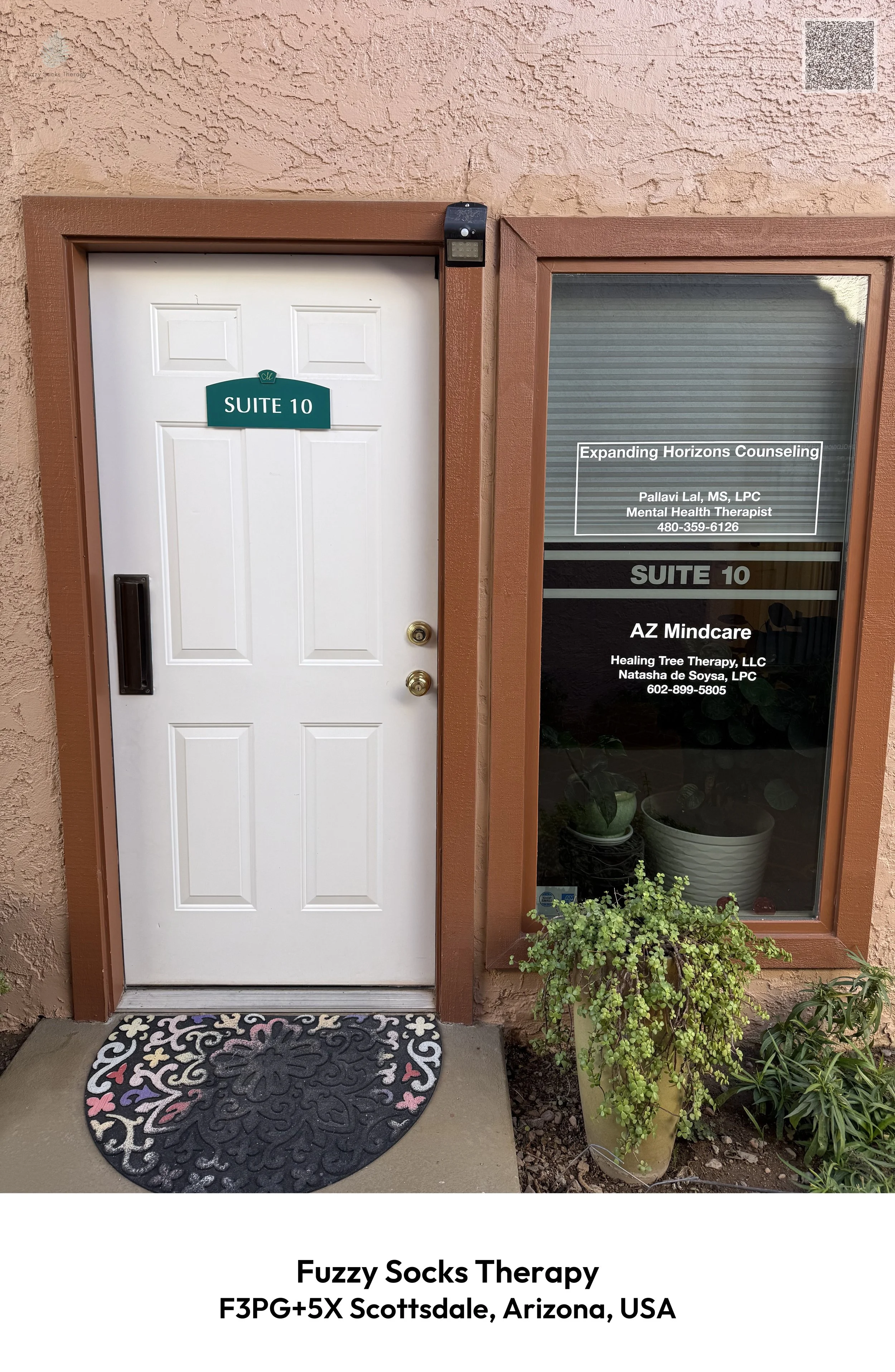
Address: 3295 N. Drinkwater Blvd., Suite 10, Scottsdale, AZ 85251
Phone: (720) 378-8454
Website: https://www.fuzzysockstherapy.com/
Email: [email protected]
Hours:
Monday: 9:00 AM - 5:00 PM
Tuesday: 9:00 AM - 5:00 PM
Wednesday: 9:00 AM - 5:00 PM
Thursday: 9:00 AM - 5:00 PM
Friday: 9:00 AM - 5:00 PM
Saturday: Closed
Sunday: Closed
Open-location code (plus code): F3PG+5X Scottsdale, Arizona, USA
Map/listing URL: https://maps.app.goo.gl/cqhwvXU4UMg6QL1YA
Embed iframe:
The practice offers in-person therapy in Scottsdale along with online sessions for clients in Arizona, Colorado, and Florida.
Clients can explore services such as trauma therapy, EMDR therapy, Deep Brain Reorienting Therapy, neurodivergent therapy, child therapy, couples therapy, discernment counseling, and parenting intensives.
Fuzzy Socks Therapy is especially relevant for people navigating trauma, dysfunctional family dynamics, ADHD, autism, relationship conflict, and emotional overwhelm.
The website presents a direct, practical therapy style focused on real tools and meaningful change rather than vague advice.
Scottsdale clients looking for trauma-informed psychotherapy can find support that combines deeper healing work with concrete skill building.
The practice also offers help for adult children of dysfunctional families, couples on the brink, and neurodivergent kids, teens, and adults.
To get started, call (720) 378-8454 or visit https://www.fuzzysockstherapy.com/ to book a free consultation.
A public Google Maps listing is also available for Scottsdale location reference alongside the official website.
Popular Questions About Fuzzy Socks Therapy
What does Fuzzy Socks Therapy help with?
Fuzzy Socks Therapy helps with trauma, dysfunctional family patterns, neurodivergence, relationship conflict, emotional overwhelm, and related challenges for individuals, couples, and families.
Is Fuzzy Socks Therapy located in Scottsdale, AZ?
Yes. The official website lists the office at 3295 N. Drinkwater Blvd., Suite 10, Scottsdale, AZ 85251.
Does Fuzzy Socks Therapy offer in-person and online sessions?
Yes. The official site says the practice offers in-person therapy in Scottsdale and online therapy in Arizona, Colorado, and Florida.
What therapy approaches are listed on the website?
The website highlights EMDR therapy, Deep Brain Reorienting Therapy, discernment counseling, play therapy, Dialectical Behavior Therapy, Emotionally Focused Therapy, and practical trauma-informed skill building.
Who provides therapy at Fuzzy Socks Therapy?
The official website identifies the therapist as Lianna Purjes.
Does the practice offer couples counseling?
Yes. The website includes couples therapy, couples intensives, and discernment counseling for couples deciding whether to stay together or separate.
Does the practice work with children and adolescents?
Yes. The site says the practice offers child therapy and support for children, adolescents, and their families.
How can I contact Fuzzy Socks Therapy?
Phone: (720) 378-8454
Email: [email protected]
Website: https://www.fuzzysockstherapy.com/
Landmarks Near Scottsdale, AZ
Drinkwater Boulevard is the clearest local reference point for this office and helps nearby clients place the practice in Scottsdale. Visit https://www.fuzzysockstherapy.com/ for service details.
Old Town Scottsdale is a familiar city landmark and a practical reference for people searching for therapy near central Scottsdale. Call (720) 378-8454 to learn more.
Scottsdale Civic Center is another recognizable local landmark that helps define the surrounding area for nearby professional services. The official website has current contact details.
Scottsdale Stadium is a well-known destination in the city and a useful point of reference for local users. Fuzzy Socks Therapy offers both in-person and online sessions.
Indian School Road is a major corridor that helps many residents orient themselves in Scottsdale. More information is available at https://www.fuzzysockstherapy.com/.
Fashion Square and the surrounding central Scottsdale area are widely recognized by local residents and visitors alike. Reach out through the website to book a free consultation.
Downtown Scottsdale is a strong local search reference for people seeking counseling and psychotherapy services in the area. The practice serves Scottsdale in person and multiple states online.
Scottsdale Road is another major route that helps define the broader service area for clients traveling from nearby neighborhoods. The practice supports individuals, couples, and families.
The Scottsdale arts and civic district is a useful area reference for those familiar with the city center. Visit the site to review specialties and next steps.
Central Scottsdale commuter corridors make this practice relevant for nearby residents who want in-person therapy, while online sessions add flexibility for clients in Arizona, Colorado, and Florida.